LINKEDIN NEWS · August 2026
LATEST UPDATES
Research milestones, university recognition, professional honors, and selected developments in battery technology.
FROM LINKEDIN

LINKEDIN NEWS · August 2026
NEW PERSPECTIVE · ACS ENERGY LETTERS

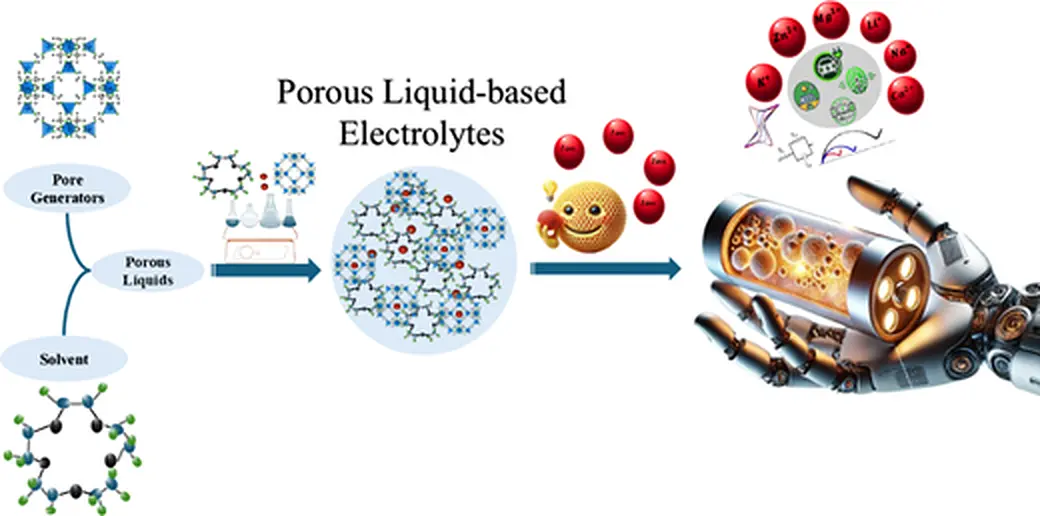
A new Perspective by Mehran Arzani, Hamidreza Mahdavi, and Vikas Berry introduces porous liquid-based electrolytes as a molecularly engineered platform for next-generation ion batteries.
Unlike conventional liquid electrolytes, porous liquids can contain permanent, accessible molecular cavities. These cavities may be tailored to selectively coordinate and shield mobile ions, creating new opportunities to improve ion mobility and conductivity while addressing dendrite growth, thermal instability, and safety.
Rather than presenting a single finished formulation, the article establishes design principles for the field. It connects porous molecular architecture, targeted electrochemical mechanisms, and computational screening with the requirements of specific battery chemistries.
The proposed roadmap outlines how porous liquid electrolytes could support batteries with higher energy density, longer cycle life, and improved reliability.
NEW REVIEW · ADVANCED MATERIALS
A comprehensive review co-authored by Mehran Arzani examines how metal–organic frameworks can retain useful structure and function even when conventional long-range crystallinity is absent.
The article brings together the fundamental concepts, design strategies, synthetic routes, and emerging forms of non-crystalline MOFs. It shows how disorder is not simply a structural limitation, but a design variable that can unlock distinctive processing behavior and application opportunities.
Looking beyond laboratory synthesis, the review charts a pathway toward industrial use. It identifies the practical challenges that must be resolved—including reproducible preparation, structural characterization, performance control, and scale-up—while highlighting opportunities for the next stage of the field.
NEW ARTICLE · ACS APPLIED MATERIALS & INTERFACES
A conductive Co3(HITP)2 catalyst couples nitrate remediation with an energy-producing zinc–nitrate battery, showing how electrochemical systems can deliver more than stored electricity alone.
The layered material combines electrically conductive π–d conjugation with abundant Co–N4catalytic sites. In nitrate electroreduction, it reaches a maximum ammonia yield rate of 56.8 mg cm−2 h−1 and approximately 91% Faradaic efficiency, supporting selective conversion of nitrate into a useful chemical product.
For energy technology, the central advance is the zinc–nitrate battery demonstration. The device uses nitrate reduction as the cathodic reaction and zinc oxidation as the anodic reaction, producing an open-circuit potential of approximately 1.45 V and a maximum power density of 5.3 mW cm−2.
The study points toward multifunctional electrochemical devices that can generate power while treating nitrate-contaminated water and producing ammonia. The conductive, molecularly defined catalyst also provides a design strategy for faster charge transfer and controlled reactions at battery electrodes. Further work on rechargeability, cycle life, system efficiency, nitrate supply, and ammonia recovery will be needed before this concept becomes a practical energy-storage platform.
FEATURED STORIES
UIC College of Engineering · 2026
UIC Graduate College · Fall 2025
UIC Chemical Engineering · 2025
Tau Beta Pi · 2025